There’s a version of success that looks exactly right on paper. And quietly exhausts you from the inside.
Today’s guest knows that version intimately.
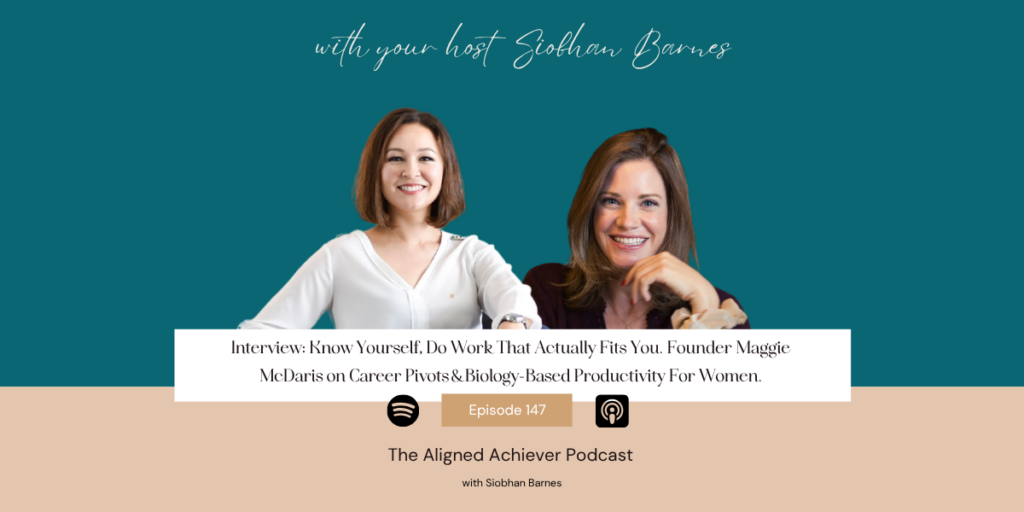
Maggie McDaris is the co-founder of Phase App, a registered dietitian turned corporate wellness expert turned entrepreneur — and one of the most candid, joyful conversations I’ve had on this podcast in a long time.
Maggie spent years scaling a high-growth startup, delivering results, ticking every box. And behind the performance, she was approaching breaking point — in ways that the people closest to her could see far more clearly than she could. She shares the full story in this episode with an honesty I deeply respect. It’s the kind of conversation that stays with you.
What followed was real recovery, a move to the UK, a wild swimming conversation in Sintra with a woman who would become her co-founder, and the creation of Phase App — a biology-based productivity tool that helps women connect the dots between their bodies and their work.
Because here is what most of us were never taught: across the four phases of your cycle, your hormones directly shape your focus, creativity, stress resilience, emotional attunement, and verbal fluency. Your biology is already influencing the version of you that shows up at work. Phase App makes that visible and actionable. Not as a reason to do less — as a way to do your best work.
We also go deep into career identity in this one. Maggie began as a registered dietitian, moved into corporate wellness, then commercial real estate, then founded a tech startup. From the outside it might look scattered. But the through line has never wavered: she is a builder, in service of the people she builds for.
She talks about the sunk cost fallacy with such joyful pragmatism and her reframe has stayed with me.
The years you spent becoming something do not have to trap you inside it. You take the skills. The values. The parts of yourself that called you there. What you leave behind is only the label.
You are not starting over. You are building on.
If you’ve ever pushed through when something was quietly asking you to pause, or wondered whether wanting something different means you’re ungrateful for what you have, this conversation is for you.
Connect with Maggie
Website: http://phaseapp.io
Link to download the app: https://my.phaseapp.io/app
Instagram: @phase_app
Tiktok: @phase_app
In this Episode We Explore:
- The silent architecture of burnout: why it so often builds underneath high performance, invisible to the woman living it, even when everyone around her can already see it clearly.
- How Maggie returned to work ten weeks postpartum, kept delivering at an extraordinary level, and convinced herself that doing more was the answer to her exhaustion and what it finally took to make her stop.
- The moment her CEO pulled her aside and said: “This is not the company we’re interested in building. What do you need?” — and why those words changed everything.
- What your hormones are actually doing across the four phases of your cycle, and how they’re already shaping your focus, creativity, stress resilience, verbal fluency, and emotional attunement in ways most of us were never taught.
- Why cycle awareness isn’t a reason to do less, it’s the key to doing your best work at the right time. And why that reframe changes everything for ambitious, achievement-oriented women.
- The sunk cost fallacy, career identity, and the art of finding your through line and why a non-linear path isn’t scattered, it’s simply a different kind of building.
- Why pivoting doesn’t mean losing what you’ve already built and what it really looks like to carry your skills, values, and self forward into what’s next.
If you enjoyed this episode and the podcast generally, I have a favour to ask  Please take two minutes to subscribe, and to write a rating and a review.
You can do that on Apple Podcasts right now by clicking here. If you are an Android user, you can follow the podcast on Spotify here. Those actions will help the podcast reach more people, and I would be truly grateful. Thank you so much.
Transcript:
Siobhan Barnes
Maggie, hello and welcome to the aligned achiever podcast. I’m your host, Siobhan Barnes, and today welcoming onto the podcast Maggie mcdaris. She is the CEO and co founder of FaZe and a thought leader at the intersection of human performance and the future of work. I invited Maggie on to the podcast because I was so intrigued by the app that she’s building phase, which is really designed to support women with a biology based productivity system that helps women connect the dots between their bodies and their workload so that they can really be at their most optimized and productive self and work sustainably in the long term, preventing burnout. And when Maggie and I first got in contact, she was talking about the phase app, but I was so intrigued by her story. She’s a registered dietitian, corporate wellness and public health expert and a well accredited professional, and she spent more than a decade translating health science into practical strategies for real life and work. Before founding phase, Maggie scaled high growth wellness businesses and led multidisciplinary teams getting a first hand view of how modern work routinely ignores human biology. So she has a background working in corporate real estate, with wellness, in that wellness industry, and we also connected on that basis. And I think she just has a beautiful ability to turn deep wellness expertise into high impact, revenue generating solutions. She’s on a mission to fundamentally reframe how we all think about productivity, performance and sustainable success. And in this podcast interview, I speak to her about her journey and how she started fazeapp, what she did before. I learned a little bit more about her journey to why fazeapp came about after working at a successful startup and finding herself in a paved place of burnout. And in the podcast episode, she also really educates us on the different seasons in a woman’s cycle and how we can work productively with our hormones, with how our brains are functioning as we transition throughout our cycles, which can be anywhere from 24 to 38 days. So if you’re interested to hear about how to practically work with your cycle, so that you can optimize your energy and your productivity to do your best work and also rest in those moments of rest, this is absolute the episode for you. And if you’re also interested to hear a little bit about Maggie and how her seemingly non linear career path got her to where she is today, this is also for you, and I really enjoyed hearing about the common threads that Maggie has identified in her career that have led her to where she is today. And so if you’re navigating a career pivot, or you’re thinking about, Oh, how do I transition? I think Maggie’s story will inspire you with how you can think about the common thread in your own career as well. I hope you enjoy. You. Maggie. Okay, so a very warm welcome. Welcome to the aligned achiever podcast. I’m your host, Siobhan Barnes, and really thrilled to have a guest on today’s episode, welcoming Maggie mcdaras to the show. Maggie is the founder of FaZe app. FaZe is a biology based productivity system designed to help women connect the dots between their bodies and their workload. And when Maggie and I recently got connected, I just thought, my goodness, this is exactly the same wavelength as the work that I do with women when they’re talking about achieving their ambition. So really happy to have Maggie on the show and share not just what she does, but also her backstory and her career, because it’s really, really interesting. So welcome, Maggie.
Maggie McDaris
Lovely to have you on. Thank you so much for having me now. I’ve been so looking forward to this conversation, obviously, really inspired by the work you do, and yeah, excited
Siobhan Barnes
to dig in today. Amazing. Well, thank you for coming along. So for those who don’t know you, I would love for you to kick off and let us know. How would you describe who you are and what it is that you do? Yeah, who I am.
Maggie McDaris
Oh, didn’t know we were getting existential at 9am on a Wednesday. No, so I am. I’m currently, I’m the CEO and co founder of Faze, as you mentioned, FaZe is a productivity system to really help women understand how their bodies and their biology impacts their brain, and therefore impacts their work and the way they show up in a variety of areas in their lives. But before that, my background is actually in wellness. So I started my career as a registered dietitian, really focusing on community health, public health, and then kind of transitioning into the corporate wellness space. And this is technically my second startup. So I was the secondary founder at another company, and still an advisor and investor in the business, and was with that company. It’s actually, it’s more of a wellness adjacent commercial real estate company. And so, you know, my career has definitely not been a linear one. It has sort of moved, you know. From, I would say, more traditional dietetics, into kind of more commercial and corporate wellness, into really just real estate, back into digital technologies and kind of health adjacent technologies. So it is, in no way been a straight line, but it’s been, you know, I think, a wonderful adventure with a lot of learnings along the way. And I think, you know, to go to your question of, who am I? I think it’s actually there is a common thread which is, which is one building things I am at my core, you know, I have that sort of entrepreneurial thing. I love to build, I love to create, I love to find new problems to solve. But I think the other sort of through line is that through everything that I have been involved with, there has been an element of improving the lives of the people who are interacting with that thing. And so obviously with dietetics, that was a little more straightforward from a health perspective. But even with my previous startup, it was really about creating workplace experiences and environments that helped the people who were using those spaces feel energized, excited, well, and so for me, regardless of sort of within what context I think those two pieces of being able to build things and also onto serving the people we’re building them for is sort of a core of who I am and what I do. Amazing.
Siobhan Barnes
Yeah, thank you for taking us there. And I wanted to ask you that very simple yet existential question, because I think for so many of the women that I work with and that are also in this audience, we’re thinking about our careers, where do we move to? And we’re sold this, I guess, ideal of something being very linear and step ladder, yes, and moving up step by step. And when we were talking and you were talking about the phase app, and I was like, curious about your background, and realized we have the real estate connection. I know, wow, that’s really cool to hear how you’ve got, obviously, a lot of different interests, and health and wellness is very much front and center. But I love that you can recognize that you’re a builder, and you can apply that in many different ways, whether it was dietetics, one on one, I guess, or wellness, of the bases, which I think is really important. I think when people think about their careers, they’re so defined by the title. So like, I’m a dietitian and that’s all I do, or I’m a lawyer, or I’m an accountant, and for you, it sounds like you identify with builder, yeah, through line. So actually, when people do ask you who you are and what you do, what comes up for you, and what’s your go to?
Maggie McDaris
Yeah, I think that line of creating things and solving problems you’re your entrepreneur, likes building businesses for the sake of building businesses, right? Like, I think I deviate from that in the sense that I’m a builder, but sort of unto solutions, unto Betterment unto I’m a very vision based values, based values, motivated person. And so yes, the thrill of building something is exciting, but actually I think building something unto a purpose is actually what sort of gets me excited and wakes me up in the morning. And I think what’s been so freeing across my career is being able to take that piece of my identity and separate it from a traditional career trajectory. One of the things I had to really reckon with this was probably 2018 when I was at my last startup. It’s a wonderful company called playbook. I had a moment of, if I go here, I am moving away from what I’ve known in the traditional wellness space, especially, I mean, I was learning a new language. You’re in commercial real estate, you know? I mean, you know, I had been a dietitian working mostly in wellness spaces, either in public health, working in third world countries or in like, very high end commercial gyms, doing one on one counseling. And then I’m I was in a space where I was learning the lingo of business for the first time, in this case of commercial real estate. And I had to have a moment of, okay, am I okay? Moving in a direction that’s sort of different from the linear path that I had been on. And I think the best piece of advice I can give around that is just the fallacy, the sunk cost fallacy of I’ve spent years and money investing in being a dietitian and being, you know, this one particular thing, if I move away from it, am I throwing all of that away? Whereas now I like joyfully shy. I call myself a retired dietitian. I don’t practice at all. There are people much more in touch with the updated research than me, in terms of, you know what you should have on your plate, probably. But I haven’t lost the things that connected me to that career trajectory, which is a desire to help people, that is still a core piece of everything I do when I show up at work. And I haven’t lost the problem solving piece, the looking at circumstances and situations and finding ways to make them better. And I would say a core thing, and maybe this is a good way to bring it back to phase, is that I haven’t lost some of the key learnings we as humans are incredibly influenced by the environments and systems around us. And in improving ourselves or our lives, we can educate, and that’s great, but unless we start to adjust those systems, that education alone isn’t really going to be enough to see the behavior change that we want to see in ourselves and other people. And so always, when you’re solving a problem, you have to have a multi pronged approach, where you can go, Okay? One, we need to educate however we can on this problem. And two, we’ve got to set up the environments and the systems. So that’s a long winded answer, but you know, I think, I think the key takeaway is, don’t get caught up with, you know, the sunk cost fallacy, and still stay connected to the things you loved about whatever version of your career you were on, but you don’t have to stick with the semantics or the particular expectations of that one career. Yeah, that’s
Siobhan Barnes
such a good, good takeaway. And I think, yeah, that sunk cost fallacy. I see that time and time again with my clients, yeah. And I had the same thing when I left real estate. I was like, I’ve got, actually, a master’s in real estate of I don’t need at all now, you know, but the strategic thing and project management skills I had, all of that still apply exactly. And, yeah, the identity piece, I think, is so big, right? Because we can think that’s us, which is why I wanted to understand, like, how you think about it. So I’m glad you took us there, but I have, like, so many questions pinging in my mind, but I did want to ask, obviously, you’ve pivoted. And there’s that well, theme, there’s the building theme. And I hear actually a real resilience and an open curiosity to be like, I don’t know this lingo, but let’s give it a go, which I think is really beautiful. What inspired you to start phase app like we were at the start that startup before? Why FaZe app take us back to that decision making process. So this is
Maggie McDaris
where, you know, in the interest of full transparency, I would like to say that there were some elements of my career that I sort of gave up control and ended up kind of having to react to. And so the story of FaZe is kind of a key component of that. So in 2021 we were in the trenches with my last startup. I mean, our CAGR. Over the seven years I was there was like 220% so our average growth, wow. And this, in this particular season, it was right when things were picking up post covid. It was, you know, we I had just launched the consulting division of the business, and then I had my daughter. And so my daughter was born in August of 2021, and I had, while my the pregnancy was fine. I had a lot of complications postpartum, I had preeclampsia, a lot of health issues, and I went back to work after 1011, weeks, wow, and never really recovered. And so sort of the combination of the intense season of growth that we were in, in running a brand new division of the company that was incredibly successful, but also very intense and high pressured, and also managing the mental, emotional changes of being a mom, and what that meant for me as someone who was so career oriented before, And then my body just breaking down on me. And so in, I believe, think it was about 12 months later, in 2022 like Christmas, 2022 I had not one, but two interventions within a two week period. One was my family, my husband and my mom were like, this isn’t sustainable. You’re not okay. My hair was falling out. I had chronic anemia. I was going to get iron infusions every couple of weeks. And when my boss, the CEO, also, and this is such a testament to her and the culture she had built, pulled me aside and goes, Hi, I can tell you’re not okay. This is not the company we’re interested in building. What do you need? And also we this is, we’re not, we’re not going to do this anymore. And so that was a, you know, a real light bulb moment for me, because the, you know, it was just the people around me were able to see so clearly that what I was doing wasn’t sustainable. And I had, I’d reached a point in my work where, in order, I was so exhausted that in order to sort of overcome that exhaustion, every day, I would add more to my plate so that I could trigger adrenaline and kind of and keep going. And it really becomes this vicious cycle and and so that was kind of a moment for me. And you know, I think that the term we’re all familiar with is burnout. I was burnt out. I was physically burned out. I was emotionally burnt out. And so I then went on kind of a journey to try to figure out, professionally, personally, what does recovery from this look like? Very practically, we hired three people under me. Wow, says a lot to help carry the burden, you know, which I think says a lot about where things were, but also, you know, about the just the pace of growth, what we were carrying. We you know, I started traveling less. So at that point, I was traveling every other week, going to new sites and new cities. We expanded to 15 markets within like two years. So I was gone a lot. So I. Cut back on the traveling, and then I started seeing functional health practitioners. I as a dietitian, as a wellness person, knew I was out of my depth, and so that was kind of tick number one, because one of the wellness practitioners I saw introduced me to the concept of cycle syncing, to this idea that every week, my hormones were doing different things and sort of priming me for different skills, and I had zero awareness. I was so disembodied. I was so disconnected from my physical self, and you know, it was impacting my work, and it was impacting everything outside of my work. So that was kind of my introduction into this idea that our biology has a big influence on the version of ourselves that we’re showing up as. And so that was kind of, you know, I was sort of drip fed, and then over the next six to eight months, was able to sort of kind of get to a place of sustainability with that as a key component. And then my family and I relocated to the UK and saw that, and had a lot of discussions with my team that that was a really good season for me to sort of move away from my role at my last startup and find the next thing. It definitely given that context, especially working us hours in the UK, you know, all of those, it just, it was it? None of it would have been, would have been good. And also, I to what our earlier conversation about the building, at that stage of the business, we were no longer building. We were scaling. We knew we had found the special sauce, right, like we had, we built, we created, we created the brand, we created the core experiences, we built the model, and now it was just about doing it more places. And so that also wasn’t really connected to that core identity piece, that thing that like, Oh, this is motivating for me. Motivated you. Yeah. So the goal was, okay, we’re going to move to UK. I’ll take six months. I’ll take a rest. We’ll breathe, we’ll see what’s next. Couple weeks later, my family and I were in Portugal, so we did this incredible program. It’s called boundless life. If you ever have a chance, it’s, it’s this, it’s they do three, three month and six week cohorts, where families can travel. So it’s basically you can World School or world camp your kids, yeah, and they have co working spaces housing, and then they have childcare camps or school for kids. And so we did a six week cohort. It’s incredible.
Siobhan Barnes
Button Syndra, yes, around that, yes, okay, I have a friend who does some work for them. So yes, okay, now,
Maggie McDaris
can I take the dog? Okay, yeah, they’re amazing. So they have ones in Sintra, they have ones in Bali, they have ones in Uruguay, they have Spain. They had their they’ve got locations all over the world. Sounds incredible. So in Sintra, I was wild swimming one morning with a fellow mom who I had met. We connected, and all of a sudden we started talking about our own journeys and understanding how our cycles were impacting our work and how as women, there was this thing that none of us had been taught, none of us have been told about our bodies. You know, we get the basics of, you know, your period, not your period, if maybe you’ve you’ve tried to conceive, you have a deeper understanding of the four phases and fertility, but you have no understanding of the multi systemic relationship between your hormones and your brain and your stress resilience and all that. And so she and I shared, you know, we like, showed each other our MacGyvered calendars where we’d been doing all of this internally. And we looked at each other one day, and we go, women, need this. Should we? Should we build this? Should we do this? And so that person was Georgie, my co founder, who conveniently lives here in the UK, lives here in Somerset. And so that really, that moment was when the idea behind FaZe was born, and it has obviously changed and shifted and become something even, you know, beyond what we could have dreamed of that day. But that that particular moment was sort of the impetus for everything. Oh my
Siobhan Barnes
gosh, there’s so much in your story that I think is so helpful. Like, to realize that your old model of productivity wasn’t working, and you are here like a pushing through of, like, force yourself through, yeah, so much so that you had to have these interventions. I’m curious. Do you think you would have stopped if nobody had intervened? Like, would you have had that awareness that you were so burnt out?
Maggie McDaris
I think my body would have eventually forced me to stop, whether that was through some sort of like psychological break or physical exhaustion, or needing something that required more medical intervention. I mean, I was already, I don’t know, maybe, you know, it’s, it’s hard to tell retroactively, like, I when I look at photos, like, I mean, my hair was just non existent. Like, you know, you it’s just things you go, how did I let it get that far? Yeah, and, you know, it’s interesting, because I would even say, now I’ve almost pendulum swung. I’m, I am. It is a daily practice to find the level of discomfort when I live in a startup world, right? Like things are always they’re fast paced, they’re moving, and to find the moment. Of, I’m not going to get back there again, and kind of trust, the trust that I’ve built with myself and my team, to not let it happen again when there’s seasons that do require long days and do require me to have my laptop out after my daughter goes to bed, and do require a little travel. And, you know, I’m, I’m still kind of navigating, I think some of the repercussions of some of the decision making that got me there.
Siobhan Barnes
Yeah, yeah. But I think you this brings up two things for me. Number one, I think many women do tolerate a lot, and they add more and more and more until it’s breaking point a lot. And then secondly, they don’t realize that there is a different way and that there is a cycle to your point. Not many people do talk about it. I learned about it like cycle sinking when I was an embodiment coaching program, because I was very disembodied, and that I was like, I need to help people get into their bodies, because strategy from the head alone will get you results, but it’s not going to feel meaningful. Yeah, yeah. And so there’s a lot there, but I think it’s interesting that I think for the listeners, it’s really good to hear you talk because, you know, I think sometimes we can pendulum swing, and it’s either like, I’m going to burn out and do lot of crazy things, exactly. And then I’ve seen when women learn about menstrual cycle awareness and cycle sinking, they go, Well, I can’t just, you know, not do anything when I’m on my period, but like you say, you’re in a startup phase, so there are things you can do with the season of your life. So I would love to hear your perspective on that. And then also, if you don’t mind, educating us on the full cycle, so that people can start to think
Maggie McDaris
about it, of course. And you know, this has been an interesting exploration I’ve also had because I am, I’m an optimizer, I’m an achiever, I’m ambitious. Yes, I am not. And so for me, as I was learning about cycle syncing, I was probably one of those people who looked at it and went, I don’t want an excuse, yes, to not do certain things. But the more I dug into it, and this is why we’re very intentional with how we position things with phase is we highlight during every phase of your cycle, there are strengths that you have access to. And so if you are like me, and you’re an optimizer and you’re ambitious, and you’re telling me that I have a strength that I may not be connected to or aware of or utilizing to its maximum potential, well that’s a that’s a that’s a problem. I want to know. I want that thing. I want access to that thing. And so even though FaZe for me, was inspired by a burnout story. I would actually say, What inspires me about FaZe today is how it supports me in my ambition, in my achievement, focus, how it supports me in feeling confident that I am executing at the highest level possible. I’m getting where I want to go. I’m, I’m, you know, my output is high, and I’m doing it in a way that is sustainable, because I’m not disembodied, yes, and it’s this glorious both end of that you don’t have to abandon. Like, you know, we talk all the time about hustle culture, and there’s so much that’s toxic about it. But if, at your core, you’re kind of, you connect it to it, because you you like working hard. You do. You enjoy that like that is something that’s giving to you. You don’t have to abandon that simply by being aware of where you are in your cycle and how that’s impacting you. You just have to reframe and go, Oh, okay. Well, if I’m going to work hard today, I want to do it in a way that’s going to maximize my output, because based on where I am in my cycle. Here’s the skills that are most easily available to me, amazing. And so you know that that I think is a core part of our value system at phase so, yeah, so we can, you know, real quick. I won’t, you know, hopefully spend too much time talking about it, but at a very high level, I will kind of walk through the four phases of the menstrual cycle, and what that means for your brain and specifically your work. So just menstrual cycle one on one, for anyone who’s listening, this is something we’ve actually been we have to constantly remind ourselves that 40% of women don’t even know when they ovulate, let alone that there’s four phases of the menstrual cycle. So we’ll start there. Your menstrual phase is when you’re bleeding. It’s typically days one to five or one to seven of your cycle. That is one of four phases. It’s when your hormone or your uterus is shedding its lining. The second phase of your cycle is your follicular phase. So that is when your body is building the eggs. Not really building the eggs, the eggs exist. It’s creating the follicles and picking one in particular to release for the purpose of ovulation. You have your ovulation phase. So ovulation typically happens somewhere between days, sort of 13 and 16 of your cycle. It varies Woman to woman. And even though ovulation itself is actually only a single moment in time, it’s when the egg is released. The few days leading up to ovulation are characterized by really peaking hormones, specifically estrogen, and a little bump of testosterone. And so we consider that a phase, typically a 48 to 72 hour phase, and then the final phase of your menstrual cycle is your luteal phase. And your luteal phase is the longest phase of your cycle. It is 14 days, roughly. I’m on a campaign any podcast I’m ever on. I say justice for the luteal phase, because it’s very easy to memify the luteal phase. Face, mostly because the late stages of your luteal phase are when Most women experience terrible symptoms of PMS, if they have PMDD any of that typically exists there. However, 14 days is a really long time, and actually sort of the beefy middle of your luteal phase has a lot of really lovely not just, you know, cognitive but emotional strengths that we can access. And I just refuse to believe as women that we have to suffer for half of our lives. And it’s a bit oversimplified to sort of villainize the luteal phase in the way that we have so those of your those are your four phases. So let’s talk a little bit about what’s happening in your brain in those four phases. And I like to start with the follicular phase, because in your follicular phase. So during your menstrual phase, we’ll get there, all of your hormones had bottomed out. They were at their lowest points across your entire cycle. As you go into your follicular phase, that is mostly characterized by a fairly quick and kind of rapid rise in estrogen. And estrogen is the hormone that’s responsible for most of the cognitive and mental changes that are happening during the season. So you’re going to notice a couple of things. One, mental energy is going to go up. Your physical energy is going to go up. The other thing that estrogen does is it has a really close relationship with dopamine. And dopamine is the motivational hormone. So you know, dopamine receptor activity goes up, dopamine creation goes up. And so you’re going to find energy is high and motivation is really easy to access. So your follicular phase is a really great time to start things. It’s also a time when you’ve got your prefrontal cortex and your hippocampus, you don’t have to remember any of this. They’re really highly activated. And so big picture thinking, strategy, creativity, sort of 40,000 foot type activities are going to feel really energizing, easy to access here. And so your follicular phase, it’s a great time to start things. It’s a great time to be creative, to engage in big picture thinking, to engage in strategy. And finally, estrogen has a direct relationship to stress resilience. So the higher your estrogen, the higher your stress resilience. So if you are going to travel for work, if you are going to have days where you have back to back meetings, where things are going to be a little more draining your follicular phase, you’re going to feel a little more resilient to those things than in other phases of your cycle. Yeah. So then you have your ovulation phase. Like I said, it’s typically two to three days. This is a time you definitely want to highlight on your calendar. It’s everything that comes with the follicular phase, and then some, the and then some is really communication skills. So what’s going to happen is estrogens at its highest point, which is going to give you a fun ability to sort of read the room, and kind of your emotional acuity gets triggered here, and that little bump in testosterone influences verbal fluency and verbal memory, so your ability to find the right words to say, to communicate clearly. So ovulation is a really good time for outward facing things and hard conversations. So because you’re going to have the energy and motivation that kind of follows through from your follicular phase, plus the ability to speak, find the right words and also gage how they’re landing, it’s a really powerful time of the month. And is, you know, I think an easy one, like, if you’re going to start thinking about, how do I align my work with my cycle? It’s a good it’s a good place to start. You know, this is just a really strong couple days in the month, and I can start to see how shifting my work to align with that works after your ovulation phase, you have your luteal phase. Now, I have two caveats. One is, right after your ovulation phase, your hormones bottom out. This was one of my biggest learnings, actually, in getting into this is that that we call it internally, we like to call it the cliff, but that post ovulation cliff is sometimes the hardest days of your cycle for some women, because not only are your hormones dropping so rapidly, they’re bottoming out, they’re not dipping. But also, in contrast to how you felt a couple days ago when you were ovulating, it’s gonna feel really significant. You’re gonna feel really low energy. You might have brain fog. So I always like to say when you’re planning around your ovulation phase, make sure to aim for earlier, because you don’t want to miss it by a day or two and have the cliff right. But the cliff is, is has been such a fun one to get feedback from our users. To go, this explains so much, because sometimes you just show up and you’re like, Why do I Why is nothing easy today? It shouldn’t be. I’m not on my period. I’m not in my lube. If what’s going on, and you go, Oh, I’m in the cliff. Got it. There’s also, like, a relationship with,
Maggie McDaris
like, super high estrogen and, like, histamine and mast cell activation. So some people might feel like inflamed and slow. So all of this stuff is going to impact, you know, the kind of couple days after you ovulate, but then we get into the lovely, lovely, meaty, middle of the luteal phase. And it’s my favorite. I love it so much. Wow. I’ve never heard someone say That’s their favorite. Oh my gosh. The luteal phase specifically like that meaty middle of the luteal phase is my absolute favorite part of the cycle. I feel grounded, I feel focused. I’m able to crank through things at a rate that’s sort of reminiscent for me, of like that adrenal. And fueled season, but is much more grounded and healthy. It is delectable. So we can let’s talk about progesterone a little bit. So which progesterone is the hormone that is kind of the driver during your luteal phase? And a couple things happen. So first, your prefrontal cortex and your temporal lobes, they are responsible for cautious and deliberate and very judgmental thinking. Also your amygdala becomes more reactive to emotional stimuli. So I’m sitting here telling you, in your luteal phase, you feel more emotionally reactive. Everyone’s like, yes, I would like to reframe that you are also much more emotionally attuned. You are more intuitive. You are way more aware of what’s going on around you, and that is a skill you can access. It is not something you have to fear, and especially if you’re aware that that is something you can take that awareness in the context of, like, did I get really short with my four year old today, but you can also go, actually, this might be a really good time to sit and check in with my gut and make gut driven, intuition driven decisions, because my judgment is at a point where it’s really easy to access. Your focus is also easier to access if you do it right. So within this phase, because dopamine is less readily available, that motivation hormone when you do complete things, it feels better you get that dopamine. It’s more of like an externally formed dopamine hit than an easily to access internal one, and it feels great. And so it’s actually a really good time for administrative and detail oriented tasks, things that are sort of easy to just crank through and tick off. And I think this is what I love about it is I can get in the weeds and feel very productive in that in the weeds space. It’s when I do all of our accounting. It’s when I do, you know, some of these tasks that you don’t really want to do when your energy is a little more, I don’t wanna say manic, but it’s, it’s, you know, kind of a little more up in the air in earlier phases of the cycle. So, yeah, luteal phase, evaluate and make, gut driven decisions, detail oriented administrative tasks, closing loops. So a nice thing to remember, follicular phase start things, momentum, creativity. Ovulation phase, maximize that stuff. Follicular phase finish. Things start to wrap things up. And then we go into your menstrual phase, and that is where you want to pause and reflect. Yeah, so a couple things happening in your brain during your menstrual phase. Your hormones are bottoming out. You’re going to feel that in physical energy, but this is the time of the month where your left inferior parietal lobe. It’s the part of the brain that helps you distinguish between perspectives. It’s the part of the brain that helps you interpret nuance. It’s where, like episodic memory, lives, for example, lives, for example, your reflection center. See, it’s that part of your brain that allows you to look back and go, Okay, what was working? What wasn’t working? That part of your brain is super activated. But my favorite part about the menstrual phase is that your left and right brain are talking. They’re communicating more efficiently during this time of the month than at any other time of the month. So that means you can take that reflection and you can turn it into action, right? So the part of your brain that’s able to kind of creatively come to conclusions is able to communicate with the part of your brain that says, Okay, let’s make a plan. And so you have a, you know, reflective, analytical thinking during your menstrual phase. And what’s so beautiful is that like that. It’s a very quiet type of productivity that sits really nicely with the physical rest that often we need during this phase of your cycle. Yeah, so I’ll stop there. I know I’ve been talking for a long time that is high level. What’s going on in your brain?
Siobhan Barnes
Yeah, amazing. Thank you. So good to hear you walk through it, and as I was hearing you talk, I’m like, reflecting on my own cycle and, like, how I experience myself and that luteal phase of, like, getting organized, I do find that to happen. I’m suddenly like, I need to organize the bathroom or the kitchen drawers, just like, get it all sorted. That need there. So it’s good to know that that fits in. And I think what strikes me as I hear you talk about the cycle is just how wise our bodies are, and there is this inbuilt system of sustainability of energy, yes. And I’ve also heard the four seasons, like into the actual seasons, like spring, summer, autumn, winter, yeah, which is, like, an easy way to think about it, for anybody who’s listening, yeah, follicular would be the springtime, and then ovulation summer, and then luteal fall or autumn, and then winter would be when you’re menstruating, the menstrual phase. So I just think it’s really beautiful and a nice way to be sustainable. So for someone who is just getting started, hasn’t thought to track her cycle and is going, huh, the cliff I’ve experienced that, what are some of the practical ways that someone can get started with starting their cycle sinking and like thinking about working more productively so they can optimize their energy?
Maggie McDaris
Yeah, of course, it’s a great question. So I would say the first thing is, don’t be overwhelmed and and there’s a temptation to see this as a magic bullet, which it isn’t right, because, one, we’re not 100% in control of our schedules. We’re not in 100 In control of our tasks. We are not aiming for perfection, perfect alignment here. It’s just awareness. Sort of see this concept as, okay, now you’ve got a new tool in your toolkit. Yeah, right. There’s another tool which we can talk about in a minute, which is sleep, which is, you know, something we’re going to be really investing in in phase over the next couple months. So one is, just, don’t be overwhelmed by all of this. Start with one phase at a time. That’s why I mentioned kind of sometimes ovulation is just like a really easy Hey, just put some stars on your calendar and go, Hey, these days are power days. I’m going to protect them for power moves for power meetings, for power tasks, right? And it can be just as easy as that. And then you move. You don’t have to change everything at once. We’re talking kind of bite size, incremental stuff. The next thing I would say is use tools that exist. Cough, cough, you know, the reason we built phase is because I don’t want you to have to know everything I just spoke about for 10 minutes to see the value in it. Yeah. So when you download phase, we integrate with all you the kind of common task managers so asana and notion and linear, etc. We pull in data from your calendars with an outlook and Google workspace, and we will give each of your events and each of your tasks a biological alignment score based on where you are in your cycle that day. And in doing that, we are able to you know, if you open up your to do list, we will actually you can rank it by due date. You can rank it by priority, or you can rank it by biology, or how I use it is combined. So I am looking at my to do list prioritized for me based on the version of myself that I am that day, and also the due dates, the practical side of stuff. And so that for me, honestly, the elimination of the decision fatigue of where do I start today? Oh, and my to do list is 1000 things long, and I go, Okay, well, here’s what’s due soon. And of those things that are due soon, here’s what my brain and my body are primed for today. Awesome. We’ll start there. So use tools that are available to you. Obviously, I will pitch face here, but there are some others, even just, you know, starting to track your cycle, if you’ve never done that before, is a really good kind of spot. And then the final thing I would say is don’t be afraid about the stigma. And this is something we when we host workshops, we actually, we like to give scripts. We know some industries like, I think about our commercial real estate backgrounds are not ready, quite ready for you to walk in, slam open the door and say, I’m on my period date to guys, what can we, you know? What can we reflect on? Yeah, so, you know, using language like I’ve been tracking when my energy and performance are at their highest, or when my energy and focus, you know, are peaking. Can we talk about shifting timelines to maximize for the patterns that I’ve recognized? I’m a manager, and someone comes to me and says, Hey, I’ve been, you know, seeing when some of my strengths are the highest. Can we start to adjust timelines to maximize my output? I’m like, okay, yeah, tell me more. So you know, I would say, don’t be nervous about starting to implement this, because there are ways you can frame it within the context of and I would say these are more like traditional corporate settings. We have a couple of pilots who are like creative agencies, where they just come in and they share their phase, you know, with everyone, every day. And wouldn’t that be wonderful, but we know that that’s not, you know how the world is. So start simple, start one phase at a time, use tools, and then be strategic about how you communicate what you’re doing, because what you’re really doing is you’re biohacking your productivity. And that’s something that most managers and workplaces will will be excited about, if you can speak to it from the from the angle of like, output and performance. Yeah, beautiful.
Siobhan Barnes
Okay, I love that. And I think that you’re really painting the picture of start with you first, yeah, and understanding yourself, and then you can advocate externally with people. I love that you’re also really practical and real about this, you know, Maggie, and it’s like, yes, ideally, spaces would be exactly open to this. But, you know, again, I think it’s when women are empowered and have that knowledge, and then can frame it in the way that you’ve just done that. It’s not just, I’m on my period. I don’t want to work today. It’s a very different conversation. Yeah, of course, you’re saying it from a productivity and optimizing perspective, which obviously benefits the organization. Yeah, and when women have these conversations and it becomes more normal and becomes part of the culture, which I guess comes back to your wellness background, about creating these bases where people can thrive
Maggie McDaris
and flourish, yeah? And it’s also, you know, don’t disqualify yourself from something. I will give a very practical example. I am late luteal today. I’m like, deeply late luteal today, I am within 24 hours of entering my menstrual phase. Yeah, I wouldn’t say it’s a good time to be on a podcast, for example, yeah, but the rest of my day is blocked off for deep work and focused tasks. And so when I looked at my calendar this week and we when we were talking about scheduling, I said, Okay, I can have a convert. This is one. It’s something I could talk about in my. Sleep, probably at this point, can feel your passion, yeah, but, but also, I do feel fairly emotionally in tune today, and I knew our conversation was also going to be about things that were a little bit bigger than just phase, but talking about career and identity and that felt really aligned and connected to me. And so I think a huge thing for all of this is you will start to learn what these strengths mean to you. I like how emotionally attuned I am during my luteal phase, and will schedule tasks that, based on everything I just said, in terms of, like, where to start, may feel a little misaligned, and I will also go okay now like that. From an energy standpoint, from a strength standpoint, was a little bit beyond, like, I wouldn’t say it was, you know, it was moderately biologically aligned. So I’m going to block off the rest of my day to do the things that I am super primed for. So it’s, we’re, you know, I’ll go getting there. It’s tax season, so
Siobhan Barnes
got some stuff to do. You
Maggie McDaris
know, that’s my afternoon, right? But it’s, it’s, it’s that it’s a really good, you know, like I said, it’s, the goal is not perfection. And also, you have to make sure you’re inputting, you’re inserting, you into that this is not, this is not a formula. This is, here’s what’s happening in your brain. You get to decide what that means for you and start organizing your life as such. Yeah, I
Siobhan Barnes
think that’s great, and I think it’s so helpful to have that you and your business partner have created face app to make this easy for women. Because, like, Qi was also like a Google spreadsheet and like, trying to figure it out, and then you try and look at your calendar, and then it’s, like, too hard, and you just go, I’ll just keep doing it the way. I know, yeah, because I do want to point people towards the face app so they can find the beautiful tool. But for those who are like, still, I don’t know, maybe I’ll just keep muscling it through, and I’ll do what I’ve done before. What would you say have been the benefits like, because you’ve done the hustle, you’ve done the work yourself to the ground, and now you’re building phase. You’re still in a growth season. You’ve got a four year old daughter, yeah? But for aligning to your cycle, what have been been some of the biggest shifts
Maggie McDaris
for you? Yeah? So the first challenge I would say to those of you who are pushing through and cranking at 110% every day, ask your colleagues, ask your friends, ask your families how they think you’re doing, because we sometimes get really focused on the stat like, Oh, this is what we have to do. This is, you know, and I just, I have to power through. I have to crank through. And I think what was so powerful for me about the conversations that were forced upon me in that moment of burnout was I thought that I was fooling everybody like I thought that I was the chaos was all sort of internal, whereas, you know, my boss noticed, and it wasn’t even that my output was poor, but it was that my ability to respond in an appropriate fashion to when things went wrong, for example, or like, there are signs that, you know, I would challenge something you may think is working, so you’re going to Keep doing it, I would ask you to get outside yourself and find some other data points to confirm that it’s working.
Siobhan Barnes
First, yeah, yeah.
Maggie McDaris
The other thing I would say is in feeling more connected to the version of myself that exists every day. I wholeheartedly and 100% believe I am better at my job, and that is massively important to me. It’s why I kept going back to this achiever thing, yeah, because there are things that I did and executed, and probably executed to a high level that if I were to do today in an A lot like I know I could do better, and that that’s the game changer piece for me, that’s the thing that because, you know, I’ll be really honest, I think if you haven’t experienced burnout, preventing it isn’t a motivator for you. Sure, this is something I’ve learned in all of my health background is like, you know, even when we talk about, oh, preventing diabetes, preventing heart disease, the prevention piece, the risk of a future thing happening is not often the motivator that we think it is. And so I would say to the people who haven’t experienced it, I’m not going to try to fear monger you and say, If you keep doing what you’re doing, you’re going to burn out. You may not, you might. But I will say, I would ask you how aware and how much are you proactively executing and contributing, and how much are you reacting to and getting done simply because you have to. And I think that is the piece where those of us who are ambitious and driven by success and achievement can go, oh, wait, am I not doing my best work? And am I, you know, and so I think, I think that I would kind of use that as a lens for those of us who are close, a little closer to the burnout world, or who have kids, or who have walked that line, been either close to it or experienced it, I don’t think I need to fear monger you. I think I can. It’s a both, and I can say, yes, no. One, I truly believe you’ll do better work, but also you’ll be able to do better work for longer. You know, I mentioned my goal after leaving my last job was to take six months off. We started phase within a month. It’s not because I, you know, I, I don’t, I don’t like to pause. I like to do and you don’t want to get into a situation where you’re forced to pause because you pushed it so far that you can’t come back. Yes, and so, you know, I think. And also, again, going back to taking it outside of you look at how you pushing yourself is impacting your team, your colleagues, the other people in your life. Because, you know, yeah, so wise,
Siobhan Barnes
so wise. And, yeah, you’re right. We often think that we’re hiding it really well, but other people can see it’s actually so much easier to see behavior in someone else than it is in ourselves as well. So getting that reflection is really beautiful. I think that’s really, really wise. Yeah. So for those who are listening and are like, Okay, I need to start this. How could get started with phase? And maybe those who are like, Oh, I’d love to do this, but my cycle’s irregular, or maybe their sleep is more important. Just if you could share a little bit about that and what’s coming so that they can get on the band.
Maggie McDaris
Watches Absolutely. Thanks for teeing me up. So yeah, you can just go to faze app.io, you can learn everything about the product, get a sense of if, it’s a good fit for you, the product as it exists today is suitable for, I would say, regularly cycling women. So that’s women who have cycles somewhere between 24 and 38 days. And we are on various types of birth control. So we do we’ve adjusted the algorithm for various types of birth control, but there are a couple, and you’ll know if you’re on one, if you’re on a progesterone only type of birth control, whether that be a patch or a pill, and you don’t have a placebo week, so a week where you do have a bleed phase is not going to be appropriate for you, because at the end of the day, so much of phases value is in its ability to it’s in its predictive nature and its ability to help you plan and organize and predict for the future. And your hormones are somewhat sort of in a forced steady state within some of those birth controls. And so, you know, phase is not as appropriate for you there. If you’re hearing this and you’re like, oh shoot, I have a regular cycles. This sounds exciting to me. Pause. Let me tell you about some cool things that are happening in the future. So one is, we are going to be integrating with wearables, so the auras, the whoops, the garments, etc. And in doing so, we’ll have access to things like ovulation data. So I’m an aura user, for example, they track your basal temperature changes, and can fairly accurately predict when you ovulate which and what’s great about that is, if you’re on, say, a coil. So if you’re on a coil and you bleed phase is applicable to you. If you’re on a coil and you’ve stopped having any sort of bleed phase isn’t applicable to you, because we have no way of telling exactly where you are in your cycle. Once we’re able to get ovulation data, we can actually start to put you in the algorithm. So be just kind of watch this space, if you will. Yeah, and if you’re listening and you’re like, none of those things apply to me. I just had a baby, for example. Or, you know, my hormones are not don’t worry, because we are adding other biological inputs into phase. So this was the other, you know, kind of big learning. It’s by I’ve used that language of like, this is a tool in your toolkit, yeah, because as we’ve dug more and more into this, your cycle is one part of your biology. It’s one part of your physiology that show that impacting how you show up at work. The other biggest one, and the one we’re tackling next, is sleep. And in sleep, we’re talking about one your chronotype. So are you morning, mid morning, intermediate, mid evening, or evening person? We’re looking at sleep debt. We’re looking at sleep pressure, so kind of sort of chronic sleep deprivation. And we will the the algorithm will be able to make recommendations for your work in the same way we do with your cycle based on your chronotype and also how you slept last night, any trends we see in sleep behavior. And what’s really interesting is it’s not just like, Okay, here’s your cycle data, here’s your sleep data. We’re going to layer them, and that’s just going to affect in diving into the research, we’ve found a really beautiful and complicated relationship between our hormones, our sex hormones, and our sleep. So in the first half of your cycle, your sleep is actually the dominant system. So how well you sleep will impact things like your ovulation timing. For example, in the last latter half of your cycle, your hormones are the dominant system. So where you are in your cycle, specifically your luteal phase and your menstrual phase has a higher impact on your sleep hormone trigger, so things like melatonin, which is why a lot of people struggle with sleep in their late luteal phase and menstrual phase. And so it’s it’s this interesting dynamic relationship. We’ve also learned that if you are a morning person, your energy fluctuations have a greater Delta than if you’re an evening person. So, you know, all of this, it’s this beautiful. I It’s, you know, I’m starting to nerd out. You can tell kind of the wellness background here, but it’s this is just beautiful alchemy of like our bodies impact how we show up so much, and our mission at phase is to be able to. To quantify that and translate that for you in a really, really, really practical way. And so if you’re interested just in understanding how your body impacts the version of you that shows up at work, then phase is for you. If it’s not for you today because you have a regular cycle, I promise it will be for you tomorrow. Post sleep, we’re going to look at stress symptom or systems, and we’re we are committed to basically giving you the fullest picture of how you can start to optimize your work based on your body.
Siobhan Barnes
So, yeah, sounds amazing. And I can really hear your passion coming through Maggie. You definitely sound so passionate about it. Thanks. Yeah. So for those of you who are listening, and it’s like, the science is cool, but it’s like, oh my God, that’s too much. That’s why you created something like this. And for me, I’m definitely like, yeah, gonna get on face app and start thinking about it, yeah?
Speaker 1
And listen, for the science nerds, there’s always like, learn more. You can hover, okay? But for those of you who are like, I don’t, I don’t need to know. I just want to know what to do. We’ve got you. We give you just a single alignment score. That’s it for that task. You just know. Okay, good, good task, bad task today. And that’s that’s all you need to know for us to be effective for you. So don’t worry. We’ve got you. I know not everyone is sitting here reading peer reviewed studies for funsies.
Siobhan Barnes
So well, that’s why you do what you do, and everyone’s got their strength. That’s why I do what I do. Yeah, and fashion
Maggie McDaris
Exactly.
Siobhan Barnes
Thank you so much, Maggie for coming on and sharing. Of course, it’s wonderful to hear about phase app, and obviously the product itself is so helpful for women, but it’s been so cool to hear your backstory as to why you created it, but also how you’ve navigated your career journey. Because, oh, thank you. I think that it’s really important for women to hear stories of how other women navigate their career choices and decisions. And you know when you are aligned, which I can hear in your passion and your voice, yeah, then I can see, for those of you listening, you’re just hearing Maggie’s enthusiasm, but she’s been very animated. She’s been talking. I’m a hand talker, but you know, when you are aligned and you have a mission and a passion, then you create beautiful things, and you know you’re building. So thank you for what you do, and thank you for sharing. No thank you so much. I’ll pop all the links into the show notes for how people can find Faye’s and get signed up and start experimenting and tracking. And, yeah, yeah, as you said, if not today, for those who aren’t regularly cycling in the future and just makes us more effective human beings, like we didn’t get a manual, no, this is a way of like, learning how to use our bodies, you know.
Maggie McDaris
So, yes, exactly, exactly, exactly.
Siobhan Barnes
Well. Thank you so much for coming on. It’s been a pleasure to have you. Thanks so much for having me. Thank you so much for tuning in to today’s podcast interview. What did you think? What did you take away from the interview with Maggie? I would absolutely love to know if you are interested in the Faze app, and would like to check it out for yourself. Please come on over to the show notes over at Siobhan Barnes, Comm, forward, slash, 147, to get all the links and understand how you can get started with the Faze app. And I would love to hear from you. You can send me a message on LinkedIn, on Instagram, reply to the email if you subscribe to the newsletter. I would love to know what’s been your single biggest takeaway from the interview with Maggie. Would absolutely love to know, and I hope that it’s really inspired you to really live this mantra that you know you are here for a reason beyond merely hustling, grinding and merely surviving, you matter. Thank you so much for tuning in, and I’ll see you next time you
Be the first to comment